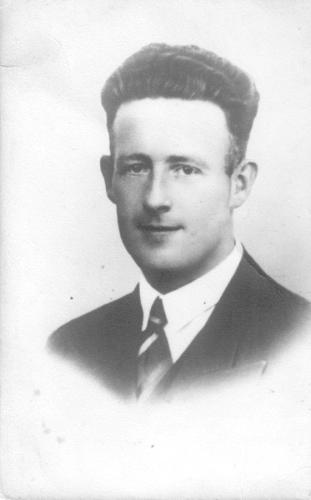
Geert Schoonman was born in Wormerveer on 31 August 1917. During the Second World War he became involved in the Dutch resistance and was known by his resistance name, Rooie Geert.
Before the war, Schoonman served in the Dutch Army. On 10 May 1940, when Germany invaded the Netherlands, he was a sergeant in the Signals Service and fought at the Grebbeberg.
After the Dutch capitulation, Schoonman was appointed as a border customs officer in Glanerbrug, near Enschede. It was there that he met Johannes ter Horst, who would later become one of the leading figures of the Knokploeg Enschede and the resistance in Twente.
In 1943, Ter Horst asked Schoonman to join the Knokploeg Enschede. From that point on, the two men worked closely together. Schoonman became an important member of the group, which carried out more than 50 armed resistance operations. Despite the dangerous nature of these actions, none of the members of the group were arrested or killed during these operations.
Schoonman took part in several important resistance actions. On 11 May 1944, he was involved in the liberation of Frits de Zwerver from the Koepelgevangenis in Arnhem. A month later, on 11 June, he also took part in the liberation of 54 prisoners from the Huis van Bewaring in Arnhem. Both operations were led by LKP leader Liepke Scheepstra.
Towards the end of the war, Schoonman was also involved in inspecting possible dropping grounds for Allied aircraft and resistance supply drops.
In the first week of October 1944, Geert Schoonman was arrested. A few days later, on 12 or 13 October, he was executed at Twente airfield. His remains were not found until October 1947, three years after his death.
Schoonman was later buried at Ereveld Loenen, where he rests among many other members of the Dutch resistance who died during the war.
In 1952, Geert Schoonman was posthumously awarded the Verzetskruis for his resistance work. His name is also listed on the Erelijst van Gevallenen 1940–1945.
Geert Schoonman's story is closely connected to the resistance in Twente, and especially to the work of the Knokploeg Enschede. His cooperation with Johannes ter Horst made him an important figure within this resistance group, although his story is perhaps less well known today.